
Introduction
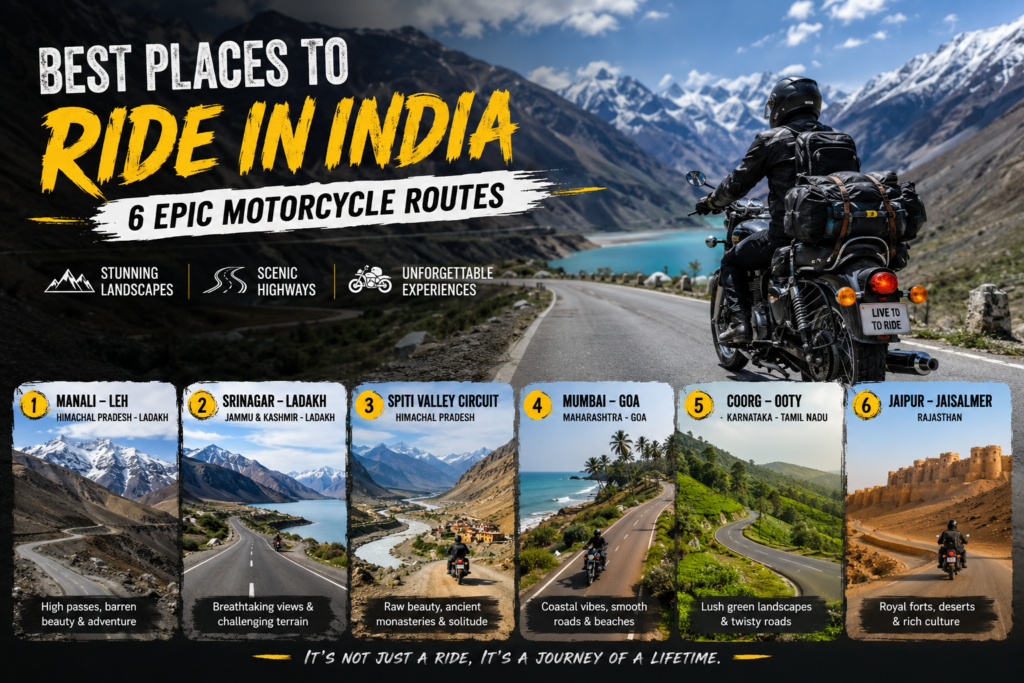
The best places to ride in India in 2026 are Leh-Ladakh for high-altitude Himalayan passes, Spiti Valley for a quieter cold-desert alternative, the Zoji La route through Kashmir, Rajasthan for forts and desert highways, the Goa-Gokarna coast for an easy winter loop, and Northeast India for Sikkim’s forested switchbacks. Each rewards a different kind of rider.
India is one of the few countries where a single motorcycle trip can take you from a 5,300-metre mountain pass to a palm-lined coastal highway, without ever leaving the same national road network. That range is exactly what makes choosing a route hard: the ride that suits an experienced adventure rider chasing altitude is not the ride that suits someone doing their first multi-day trip on a rented Royal Enfield. This guide breaks down six regions worth genuinely planning a trip around, what has changed about permits and road access going into the 2026 riding season, and how to decide which one fits your time, budget, and experience level.
Leh-Ladakh: India’s Bucket-List Himalayan Ride
The best places to ride in India -classic route runs from Delhi or Manali to Leh, then out to Nubra Valley and Pangong Tso before looping back. This is the ride most people picture when they picture India on a motorcycle, and the scenery, sand dunes backed by snow peaks, turquoise high-altitude lakes, and monasteries built into cliff faces, largely explains why.
One practical change worth knowing before you plan the approach: the Atal Tunnel now bypasses the old Rohtang Pass entirely, cutting hours off the Manali-to-Leh leg and removing the permit that Rohtang itself used to require. Once you’re on the high plateau, Khardung La, one of the highest motorable passes in the region at around 5,359 metres, remains a rite of passage on the way to Nubra Valley.

When should you ride to Leh-Ladakh?
The high passes are only open from around June to September; the rest of the year they’re closed by snow, so this is a strictly seasonal ride rather than a year-round one.
Do you need a permit for Ladakh in 2026?
As of 2026, Indian citizens no longer need a separate Inner Line Permit for most of Ladakh. That requirement was replaced back in 2021 with an Environment/Development Fee, paid online through the Ladakh Autonomous Hill Development Council’s official portal and carried as a printed receipt. Foreign nationals still need a Protected Area Permit, typically arranged through a registered agent in Leh, and solo foreign riders are generally not permitted in the protected high-altitude zones; groups of two or more are required.
Spiti Valley: The Quieter Cold-Desert Circuit
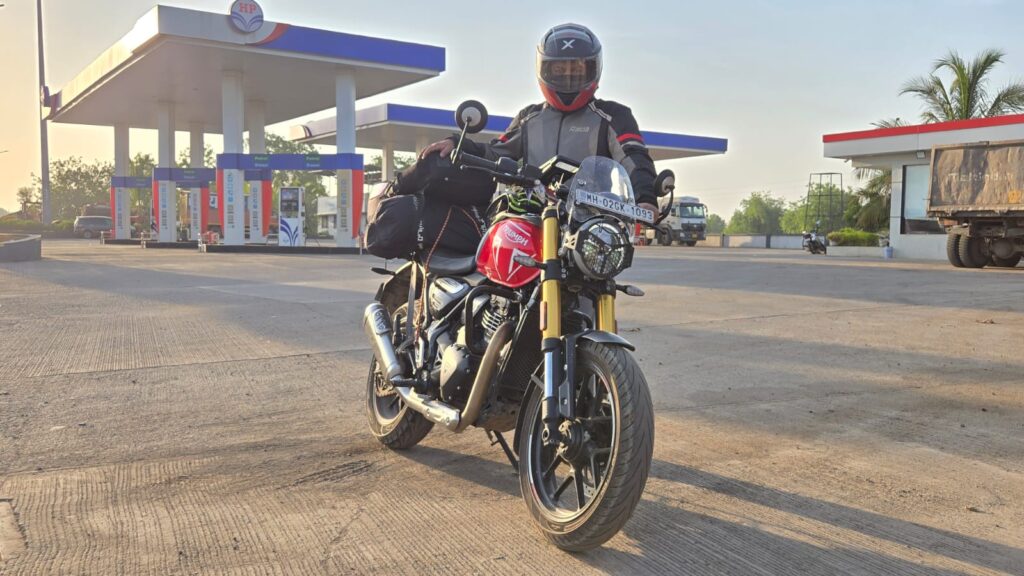
The best place to ride in India is Spiti, which runs from Manali to Kaza over Kunzum La, then on through Tabo, Nako, and Kalpa before dropping back toward Shimla. It’s smaller in scale than the Ladakh circuit, rawer, and noticeably quieter: a high cold desert wedged between Tibet and the rest of India, with the character of the ride changing almost daily, from green forest around Jibhi and the Tirthan Valley to apple-orchard country at Kalpa, where the Sutlej River cuts through the mountains.
Spiti is often the route riders choose the second time they head into the Himalayas, once the novelty of Ladakh’s crowds has worn thin and they want the mountains without the convoy of tourist jeeps.
Do foreigners need a permit for Spiti Valley?
Indian nationals don’t need an Inner Line Permit for Spiti itself, though they should carry a valid photo ID. Foreign nationals travelling in a group of two or more can usually obtain the necessary permit at Keylong district; solo foreign travellers cannot ride the route alone.
Kashmir’s Zoji La Route: Culture and Altitude Together
The Srinagar-to-Leh route via Zoji La and Sonamarg offers a different entry into Ladakh than the Manali approach: it combines the Kashmir Valley’s meadows, lakes, and old-town architecture with a gradual climb toward the high plateau, which some riders find easier for acclimatisation than jumping straight from Manali’s lower elevation to Leh’s thinner air. The route runs through Kargil before joining the wider Ladakh road network.
Is the Zoji La route harder than the Manali route?
It’s a different kind of demanding rather than simply harder: narrower stretches and more variable weather around the pass itself, offset by a gentler overall altitude gain and considerably more cultural texture along the way.
Rajasthan: Forts, Desert Highways and Easier Riding
A loop through Jaipur, Jodhpur, Jaisalmer, and Udaipur gives you sandstone forts, desert highways, and some of the best-maintained tarmac of any long-distance route, the best places to ride in India, with none of the altitude or permit complications of the Himalayan rides. It’s the route most commonly recommended to first-time long-distance riders in India, domestic or foreign, because the road quality and infrastructure (fuel, mechanics, accommodation) are consistently good.
October through March is the practical window; Rajasthan’s summer heat, often well above 40°C in the desert districts, makes daytime riding genuinely dangerous rather than just uncomfortable.
Goa to Gokarna: A Gentle Winter Coastal Loop
The coastal stretch of NH66 between Goa and Gokarna is the easiest ride on this list: short daily distances, beach towns to break up the route, and the Western Ghats visible inland for most of the way. It suits riders who want the feeling of a road trip without the logistics of altitude acclimatisation, permits, or long unsupported stretches between fuel stops.
November to February is the sweet spot, after the monsoon has cleared the coastal roads and before the pre-summer humidity sets in.
Northeast India: Sikkim and the Ride Almost Nobody Does
Next, the best places to ride in India include Sikkim’s forested switchbacks around Gangtok, Tsomgo Lake, and the zigzag mountain road at Zuluk — routes that far fewer riders have discovered compared with Ladakh or Rajasthan, which is precisely the draw for riders who’ve already done the more famous routes. Roads are narrower and more weather-dependent than in the West, and the region offers genuinely different terrain — dense forest rather than high desert — within a much shorter riding distance per day.
What permits does Sikkim require?
Indian citizens need an Inner Line Permit for restricted areas such as Nathula and parts of North Sikkim, generally straightforward to arrange in Gangtok. Foreign nationals require a Protected Area Permit, and some border-adjacent zones remain off-limits to foreign travellers entirely, regardless of permit status.
Comparing the Best Places to Ride in India
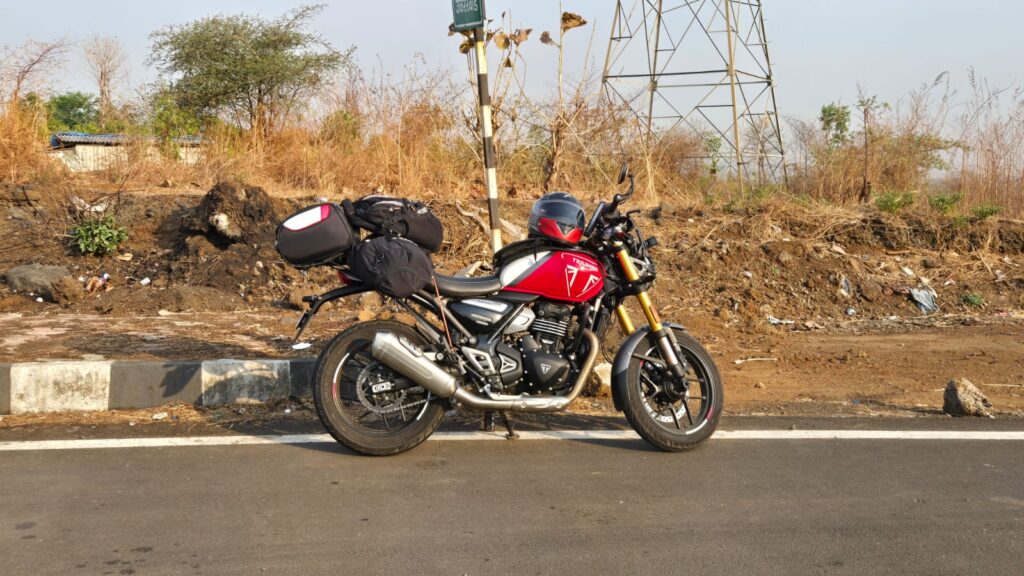
A quick side-by-side: The best places to ride in India — six routes above suit very different riders, budgets, and time windows.
| Route | Best Season | Difficulty | Permit / Fee Needed | Ideal Bike |
| Leh-Ladakh (Manali/Delhi-Leh) | June-September | High (altitude, cold, long days) | EDF for Indians; PAP for foreigners via a Leh agent | Adventure tourer, e.g. Royal Enfield Himalayan |
| Spiti Valley circuit | Mid-June-early October | High (altitude, water crossings) | None for Indians; foreign nationals need 2+ in a group, permit at Keylong | Adventure tourer or well-maintained 350cc |
| Kashmir’s Zoji La route | May-October | Medium-High | None beyond standard ID for Indians on this stretch | Adventure tourer or touring 350-500cc |
| Rajasthan desert loop | October-March | Low-Medium (good tarmac, heat in summer) | None | Cruiser or standard tourer, e.g. Classic 350 |
| Goa-Gokarna coast | November-February | Low (easy, short daily distances) | None | Any commuter or cruiser |
| Sikkim / Northeast India | October-May (avoid monsoon) | Medium (narrow roads, permits) | Inner Line Permit for Indians; Protected Area Permit for foreigners | Adventure tourer or 350cc standard |
Pre-Ride Checklist
Before setting out on any of the routes above, especially the Himalayan ones:
- Get the bike serviced and carry basic spares (clutch cable, brake pads, puncture kit) rather than relying on finding a mechanic in remote stretches.
- Wear proper riding gear: an armoured jacket, an ISI- or DOT-rated helmet, riding gloves, and waterproofs for mountain routes.
- Complete permit or fee paperwork in advance and carry multiple printed copies; digital screenshots are routinely rejected at remote checkpoints.
- Build in one or two acclimatisation days before crossing high passes on the Ladakh or Spiti routes; altitude sickness is the most common reason riders cut Himalayan trips short.
- Take out travel insurance that explicitly covers high-altitude motorcycling, since many standard policies exclude it.
- Download offline maps and note the last fuel stop before long unsupported stretches; some sections of the Ladakh and Spiti routes go well over 100 km between pumps.
- Check current road status before departure, particularly for Border Roads Organisation updates on Himalayan passes, since landslides and snow can close a route with little notice.
Expert Tips from Experienced Himalayan Riders
Riders who’ve done the Ladakh and Spiti circuits repeatedly tend to agree on a few things that don’t show up in a standard itinerary. Riding the route via Manali on the way out and returning via the Srinagar-Zoji La side (or vice versa) covers more of the region’s scenery than doing the same road twice. Solo travel is legally and practically restricted in several protected zones, so pairing up isn’t just a permit formality; it’s also the safer call on roads where help can be hours away. And the single most common planning mistake isn’t the route itself but the schedule: riders who allow a rest or acclimatisation day every two to three days of high-altitude riding report far fewer problems with altitude sickness and fatigue than those trying to cover the full loop in the shortest possible time.
Frequently Asked Questions
What is the best time of year to ride in India?
It depends on the region: Leh-Ladakh and Spiti are only open June to September; Rajasthan and the Goa-Gokarna coast are best October to February or March; Sikkim is rideable October through May, outside the monsoon.
Do I need a permit to ride to Ladakh in 2026?
Indian citizens no longer need a separate Inner Line Permit; instead you pay an Environment/Development Fee online and carry the printed receipt. Foreign nationals still need a Protected Area Permit, usually arranged through a registered Leh-based agent.
Which motorcycle is best for riding in India?
For the Himalayan routes, an adventure tourer such as the Royal Enfield Himalayan is the most commonly used bike, prized for its ground clearance and manageable weight on rough terrain. For Rajasthan, Goa, and other lower-altitude routes, a standard cruiser or touring 350cc bike is generally sufficient.
Is it safe to ride solo in India?
On Rajasthan and coastal routes, solo riding is common and generally safe with standard travel precautions. In the protected high-altitude zones of Ladakh and Spiti, authorities often don’t permit solo foreign travel at all, and even Indian riders should travel with at least one companion, given how remote some stretches are.
How many days do I need for the Manali-Leh ride?
Most riders budget 10 to 14 days for a Manali-Leh-Manali loop, including Nubra Valley and Pangong Tso, with at least one or two rest days built in for altitude acclimatisation.
What is the best route for a first-time long-distance rider in India?
Rajasthan is the route most commonly recommended for a first attempt, thanks to good road surfaces, reliable fuel and mechanic access, no altitude concerns, and no permit requirements.
Do foreign riders need a permit for Sikkim?
Yes. Foreign nationals require a Protected Area Permit for restricted zones in Sikkim, and some border-adjacent areas remain closed to foreign travellers regardless of permit status.
Conclusion
There’s no single best place to ride in India, only the best route for the trip you actually have time and budget for. Two to three weeks in summer and a craving for the classic Himalayan experience? Leh-Ladakh delivers it. Already ticked that off and looking for something quieter — Spiti or the Zoji La route are the natural next steps. New to long-distance riding or travelling outside the June–September window? Rajasthan or the Goa-Gokarna coast gives you a comfortable long-distance ride without the altitude or permit complexity. Whichever route you choose, sort permits and paperwork early, build rest days into the schedule, and check current road status before you leave — conditions on India’s mountain routes can change faster than any itinerary accounts for.
Suggested Internal Links
Best Places to Bike Ride in Maharashtra in Monsoon
Uncharted Monsoon Trails: Remote Indian Sanctuaries 2026
Monsoon Trekking in India: Guide
Suggested External References
- Ladakh Autonomous Hill Development Council (LAHDC) official e-permit portal for current environment/development fee rates and the application process.
- Sikkim Tourism Department’s official Inner Line Permit information for restricted-area rules in Northeast India.
- Border Roads Organisation (BRO) road status updates for real-time pass and highway closures in the Himalayas.
- Ministry of Home Affairs guidance on Protected Area Permits for foreign-national entry rules in border-adjacent regions.
- India Meteorological Department regional forecasts for pre-departure weather checks on mountain routes.