
Introduction
Best forts for trekking in Maharashtra are home to nearly 350 hill forts across the Sahyadri (Western Ghats) range, and 15 of them stand out for trekking: Rajgad, Torna, Harishchandragad, Raigad, Lohagad, Rajmachi, Sinhagad, Kalsubai (fort-studded ridge), Ratangad, Harihar, Prabalgad-Kalavantin, Korigad, Tikona, Visapur, and Sudhagad. Together they cover every difficulty level, from a two-hour family walk to a two-day, high-endurance ridge crossing. This guide breaks each one down by difficulty, elevation, base village, and the best season to go, so you can pick a fort that matches your fitness level rather than just your Instagram feed.
These forts aren’t just scenic viewpoints — most were built or fortified during the Maratha Empire under Chhatrapati Shivaji Maharaj, and several, including Raigad, are now recognised as part of the UNESCO World Heritage “Maratha Military Landscapes” nomination. Trekking to them is as much a walk through 17th-century military history as it is a hike.

Quick Comparison Table
| Fort | District / Nearest Hub | Height (ft) | Difficulty | Trek Duration | Best Season |
| Sinhagad | Pune | ~4,305 | Easy | 1.5–2 hrs | Year-round |
| Lohagad | Lonavala, Pune | ~3,450 | Easy | 1.5–2 hrs | Monsoon & winter |
| Tikona | Kamshet, Pune | ~3,500 | Easy–Moderate | 1.5–2 hrs | Monsoon & winter |
| Korigad | Lonavala, Pune | ~2,800 | Easy–Moderate | 1.5–2 hrs | Monsoon & winter |
| Rajmachi | Lonavala, Pune | ~2,710 | Moderate | 2–3 hrs | May (fireflies), monsoon, winter |
| Visapur | Lonavala, Pune | ~3,000 | Moderate | 2 hrs | Monsoon & winter |
| Sudhagad | Pali, Raigad | ~2,150 | Moderate | 3–4 hrs | Post-monsoon & winter |
| Prabalgad–Kalavantin | Panvel, Raigad | ~2,300 | Moderate–Difficult | 3–4 hrs | Winter (avoid monsoon) |
| Rajgad | Pune | ~4,250–4,600 | Moderate | 2.5–5 hrs | Monsoon & winter |
| Torna (Prachandagad) | Velhe, Pune | ~4,600 | Moderate–Difficult | 2.5–3 hrs | Post-monsoon & winter |
| Raigad | Mahad, Raigad | ~2,700–4,429 | Moderate (ropeway avail.) | 2–3 hrs on foot | Year-round |
| Harishchandragad | Ahmednagar | ~4,671 | Difficult | 5–6 hrs | Post-monsoon & winter |
| Ratangad | Bhandardara, Ahmednagar | ~4,255 | Difficult | 3–4 hrs | Post-monsoon & winter |
| Harihar | Trimbakeshwar, Nashik | ~3,676 | Difficult | 1.5–2 hrs (steep) | Jul–Feb (check closures) |
| Alang–Madan–Kulang (AMK) | Kalsubai range, Nashik | up to ~4,850 | Very Difficult | 2–3 days | Post-monsoon & winter |
Heights and durations vary slightly by source and route; treat these as planning estimates, not GPS-verified figures.
Beginner-Friendly Fort Treks
Sinhagad Fort — The Classic First Trek Near Pune
Best Forts for Trekking in Maharashtra -Sinhagad, at roughly 4,305 feet, is one of the most popular trekking spots in Maharashtra, known for its historical significance and the 1670 Battle of Sinhagad. The climb is short and well-marked, which is why it’s usually recommended as a first fort trek for beginners, families, and even school groups. On the way up, you pass Khadakwasla Dam viewpoints, and the summit has ruins, temples, and stalls selling the fort’s famous pithla bhakri and buttermilk.

Base village: Sinhagad village, 25 km from Pune city
Difficulty: Easy
Best for: First-timers, families, sunrise treks
Lohagad Fort — Iron Fort with an Easy Ridge Walk
Best Forts for Trekking in Maharashtra – Perched at about 1,050 meters (roughly 3,450 feet), Lohagad Fort separates the Indrayani basin from the Pawna basin and is one of the most visited forts in Maharashtra as part of a Lonavala trip. The trek follows a wide, stepped path to Vinchu Kata, a scorpion-tail-shaped promontory that’s the fort’s signature photo spot. It pairs well with a visit to neighbouring Visapur Fort for trekkers who want a longer day out.
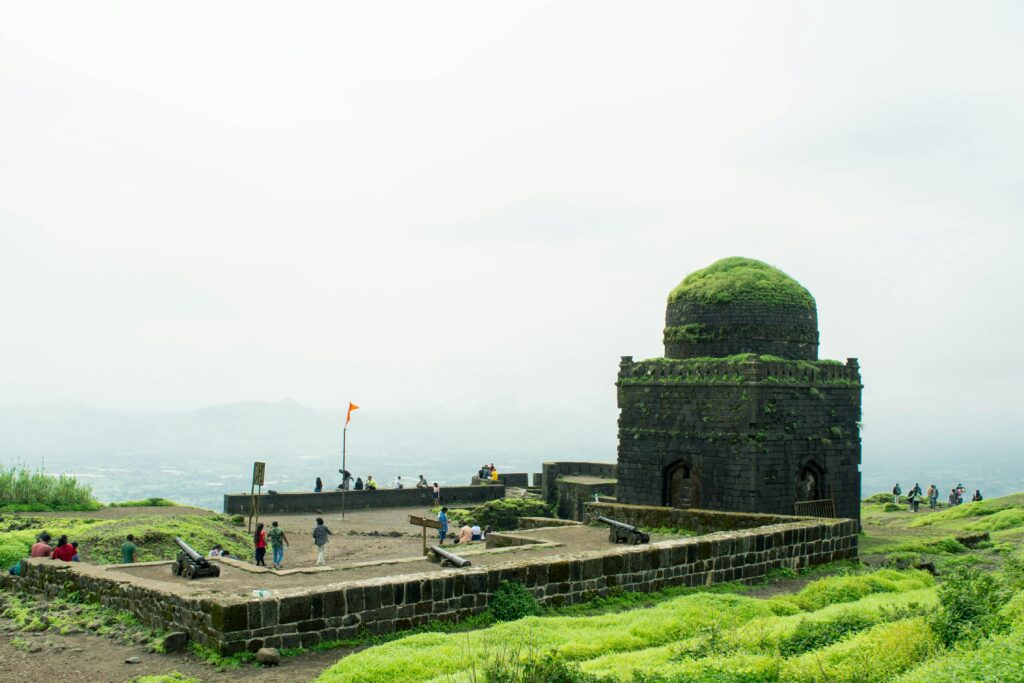
Base village: Lohagadwadi, near Lonavala
Difficulty: Easy
Best for: Monsoon day trips, beginner groups
Tikona Fort — Triangular Peak with Cave Shelters
Best Forts for Trekking in Maharashtra – Tikona (also called Vitandgad) is a triangular hill fort near Kamshet in the Maval region, offering views over Pawna Lake. The initial trail is a moderate climb through scrub forest, with a short rocky scramble near the top; ancient caves partway up serve as a natural rest stop and, in a pinch, shelter from sudden rain.
Base village: Tikona Peth
Difficulty: Easy to moderate
Best for: Half-day treks combined with Pawna Lake camping
Korigad Fort — Family-Friendly with Cannons and Two Lakes
Best Forts for Trekking in Maharashtra – Korigad rises to roughly 2,800 feet and is unusual among Maharashtra forts because its fortification wall is almost fully intact, letting trekkers walk the entire rampart. Two small lakes and several old cannons remain on the plateau, making it a satisfying half-day trek that doesn’t demand technical skill.
Base village: Peth Shahapur, near Lonavala
Difficulty: Easy to moderate
Best for: Photography, casual weekend trekkers
Moderate Fort Treks
Rajmachi Fort — Twin Peaks and Firefly Season
Best Forts for Trekking in Maharashtra – Rajmachi has two fortified peaks, Shrivardhan and Manaranjan, connected by a plateau reached via a half-hour climb from the base village of Udhevadi. Historically, it guarded the Bor Ghat trade route between Khopoli and Khandala. Rajmachi is also one of the few forts in Maharashtra known for a natural spectacle: synchronous firefly displays in the surrounding forest during the pre-monsoon weeks of May.
Base village: Udhevadi (via Lonavala or Karjat)
Difficulty: Moderate
Best for: Overnight camping, firefly season (May), monsoon trekking
Visapur Fort — Lohagad’s Bigger, Quieter Neighbour
Best Forts for Trekking in Maharashtra – Visapur sits across a saddle from Lohagad and, despite being the larger of the two forts, sees far fewer visitors. Broken bastions, old water cisterns, and grassy plateaus make it a favourite for trekkers who want Lohagad’s views without Lohagad’s weekend crowds.
Base village: Bhaje or Patan village, near Lonavala
Difficulty: Moderate
Best for: Trekkers seeking a quieter alternative to Lohagad
Sudhagad Fort — Ancient Ruins Near Pali
Best Forts for Trekking in Maharashtra – Also known as Bhorapgad, Sudhagad is a hill fort located near Pali that takes you through dense forests and scenic trails, with the fort boasting ancient ruins including palaces, water cisterns, and a temple dedicated to the deity Bhorai Devi. The trek typically runs 3–4 hours and can be combined with a visit to the nearby Pali Ganpati temple.
Base village: Thakurwadi, near Pali
Difficulty: Moderate
Best for: History enthusiasts, combining with Konkan temple visits
Prabalgad and Kalavantin Durg — The Viral Pinnacle Climb
Best Forts for Trekking in Maharashtra -Prabalgad Fort sits at an altitude of roughly 2,300 feet in the Western Ghats between Matheran and Panvel, and is one of the most beautiful small forts in Maharashtra. Right next to it, Kalavantin Durg requires climbing exposed, rock-cut, zigzagging steps up the mountain, with no railings for much of the way. This route has gone viral repeatedly on social media for its dramatic staircase, but the exposure means it deserves real caution — it is genuinely unsuitable for anyone uncomfortable with heights, and it’s best avoided entirely in the monsoon when the steps turn slick.
Base village: Thakurwadi or Chowk, near Panvel
Difficulty: Moderate for Prabalgad, difficult and exposed for Kalavantin Durg
Best for: Experienced trekkers comfortable with height exposure; avoid Kalavantin in the monsoon.
Rajgad Fort — The King of Forts
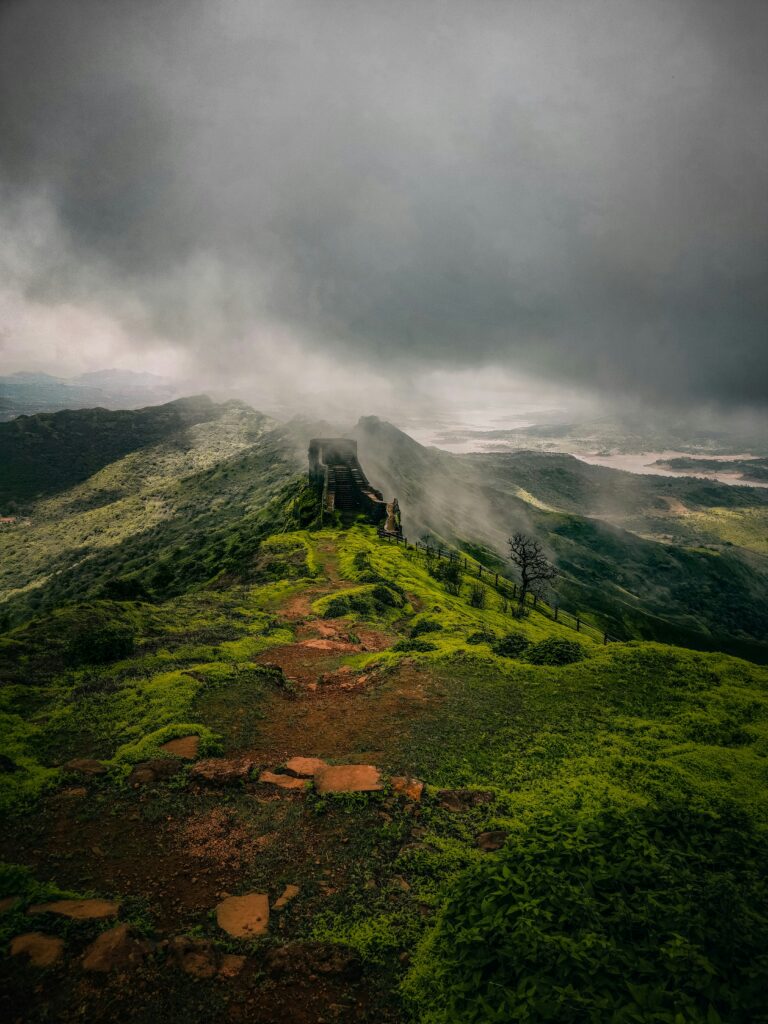
Best Forts for Trekking in Maharashtra – Rajgad served as Chhatrapati Shivaji Maharaj’s capital for roughly 25–26 years and remains one of the largest hill forts in the Sahyadris, with estimates of its height ranging from about 4,250 to 4,600 feet depending on the measurement point. The fort has three fortified spurs, or machis — Padmavati, Suvela, and Sanjeevani — around a central citadel called Balekilla. From the Balekilla, the view extends across more than twenty other forts, including Torna, Sinhagad, Raigad, and Lohagad, making sunrise from Rajgad one of the most rewarding views in the entire trekking circuit.
The most popular approach, via Gunjavane village, involves a steep final climb to the Balekilla that gains around 500 feet over rock patches fitted with support ropes. Fixed ropes make this manageable, but they should be used only for balance, not full body weight.
Base village: Gunjavane (moderate route), Pali (easier route)
Difficulty: Moderate
Best for: Overnight camping, history-focused treks, sunrise photography
Torna Fort (Prachandgad) — Shivaji’s First Conquest
Best Forts for Trekking in Maharashtra – Torna was the very first fort captured by a young Chhatrapati Shivaji Maharaj in 1643, marking the symbolic start of the Maratha kingdom. It stands close in height to Rajgad and connects to it via a demanding ridge trail. As a standalone day trek from Velhe village, Torna takes roughly 2.5–3 hours to summit and offers sweeping views back toward Rajgad.
Base village: Velhe
Difficulty: Moderate to difficult
Best for: History-driven treks, combining with Rajgad for a two-fort crossing
Raigad Fort — Shivaji’s Coronation Capital
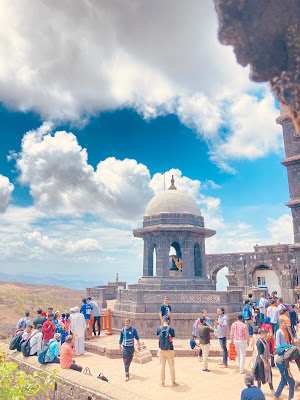
Best Forts for Trekking in Maharashtra -Raigad is the hill fort where Shivaji Maharaj was crowned king in 1674, after which he made it his capital, and it is now recognised as a UNESCO Heritage Site as part of the Maratha Military Landscapes. Unlike most forts on this list, Raigad has a ropeway option alongside the traditional trekking trail up roughly 1,400–1,700 stone steps, so it’s accessible to a wider range of fitness levels. On top, visitors can see Shivaji Maharaj’s samadhi (memorial), the Takmak Tok cliff, and the durbar hall ruins.
Base village: Pachad, near Mahad
Difficulty: Moderate on foot (or easy via ropeway)
Best for: History-focused travellers, families wanting the ropeway option
Advanced & High-Endurance Fort Treks
Harishchandragad — The Konkan Kada Classic
Best Forts for Trekking in Maharashtra – Harishchandragad is one of the oldest and most revered forts in Maharashtra’s trekking circuit, known for the Konkan Kada, a massive concave cliff face, along with ancient rock-cut caves and ruins near the Harishchandreshwar temple. The trek to the summit plateau is long and involves dense forest, rocky sections, and steep climbs, typically taking five to six hours depending on the chosen route.
Base village: Khireshwar or Pachnai
Difficulty: Difficult
Best season: October to February (monsoon trails are scenic but slippery)
Ratangad Fort — The Eye of the Needle
Best Forts for Trekking in Maharashtra – At an elevation of roughly 4,255 feet near Bhandardara, Ratangad is known for its Nedhe, a natural rock hole locally called the “Eye of the Needle”, along with cave-cut boulders and panoramic views of neighbouring giants like Kalsubai, Alang, and Kulang. The fort’s ramparts and four gates are still partly visible, and the climb includes steep, forested sections that reward fitness with genuinely wild scenery.
Base village: Ratanwadi, reached via Bhandardara
Difficulty: Difficult
Best season: October to February
Harihar Fort — The 117 Rock-Cut Steps
Harihar Fort’s defining feature is a one-metre-wide staircase with hand-carved niches chiselled directly into the rock face, forming 117 near-vertical, exposed steps — the only path to the summit. At the top, the fort reaches roughly 3,676 feet above sea level, with a small temple, a stone pond, and views stretching across several other Nashik district forts on a clear day. Because of the exposure and steep gradient, the fort has historically been closed to visitors during the peak of monsoon season for safety, reopening only once conditions stabilise, so it’s worth checking current access status before planning a monsoon trip.
Base village: Nirgudpada (via Igatpuri/Kasara) or Harshewadi (via Nashik, easier route)
Difficulty: Difficult (short but steep and exposed)
Best season: Post-monsoon and winter; check for seasonal closure notices.
Alang–Madan–Kulang (AMK) — The Ultimate Trekker’s Trilogy
The AMK trio, part of the Kalsubai range in Nashik district, is widely regarded as the toughest fort trekking circuit in Maharashtra. It involves rock-climbing sections with fixed ropes, multi-day camping, and significant technical exposure — this is not a trek for beginners or even most intermediate trekkers, and it should only be attempted with an experienced guide or trekking group carrying proper safety gear.
Base village: Ambewadi
Difficulty: Very difficult (technical)
Best season: Post-monsoon and winter; avoid solo or unguided attempts
Pre-Trek Checklist
- Check weather and fort-access status (some forts, like Harihar and Kalavantin, restrict access in heavy monsoon)
- Carry at least 2 litres of water per person; most forts have unreliable or seasonal water sources
- Wear trekking shoes with solid grip — sandals and sneakers are unsafe on wet rock
- Start early (before 6–7 AM) to avoid midday heat and afternoon fog on ridge sections
- Carry a basic first-aid kit, torch/headlamp, and a fully charged phone with offline maps
- Inform someone of your route and expected return time
- Carry back all trash — most of these forts are protected monuments and ecologically sensitive
- For overnight treks (Rajgad, Rajmachi, AMK), confirm temple/camping permissions locally before arrival
Expert Tips
- Match the fort to your fitness level honestly. A moderate ridge trek like Torna in the rain is a very different experience from Torna in December — conditions change difficulty more than distance does.
- Avoid exposed rock-step forts (Harihar, Kalavantin Durg) during heavy monsoons. Wet basalt on a near-vertical, railing-free staircase is the single biggest cause of trekking accidents on this list.
- Go with a local guide for AMK and unmarked ridge traverses. GPS trails online are frequently outdated, and several sections require rope work.
- Weekday visits beat weekend visits at popular forts like Sinhagad, Lohagad, and Rajmachi, where trail congestion on Saturdays and Sundays can add real time to your climb.
- Carry cash for local stalls. Base villages often run small tea and bhakri stalls without card or UPI access.
FAQs
Q1. Which is the easiest fort to trek in Maharashtra for beginners?
Sinhagad, Lohagad, and Korigad are generally considered the easiest, with well-marked trails, short durations of under two hours, and gentle gradients suitable for first-time trekkers and families.
Q2. Which fort trek in Maharashtra is the most difficult?
The Alang–Madan–Kulang (AMK) circuit is widely regarded as the toughest, requiring technical rock climbing, multi-day planning, and an experienced group or guide.
Q3. What is the best season for fort trekking in Maharashtra?
Post-monsoon and winter (October to February) offer the clearest views and driest trails for most forts. Monsoon (June–September) is scenic and popular for lower-altitude forts like Lohagad and Rajmachi, but exposed, rock-cut-step forts such as Harihar and Kalavantin Durg become genuinely hazardous in heavy rain.
Q4. Are these fort treks safe for solo trekkers?
Easy and moderate forts near Pune and Lonavala (Sinhagad, Lohagad, Tikona, and Korigad) are commonly trekked solo. Difficult and technical treks (Harishchandragad, Ratangad, AMK, and Kalavantin Durg) are safer with a group or a registered trekking organisation, particularly given exposed sections and unreliable mobile network coverage.
Q5. Do I need permits or pay an entry fee for these forts?
Most forts, including Rajgad and Torna, currently have no entry fee, though this can change, so it’s worth checking locally. Raigad Fort charges a fee for the ropeway. Always confirm current rules with the local forest or archaeology department before your trip.
Q6. How do I reach these forts from Mumbai or Pune?
Most forts in this list are within a 2–4-hour drive of Mumbai or Pune. The Lonavala-cluster forts (Lohagad, Visapur, Tikona, Korigad, and Rajmachi) are reachable by local train to Lonavala, followed by a shared taxi. Pune-cluster forts (Sinhagad, Rajgad, and Torna) are best reached by private vehicle or state transport bus to the base village.
Q7. Can beginners attempt Harishchandragad or Ratangad?
Both are rated difficult due to long duration, steep sections, and remote terrain. Reasonably fit beginners can attempt them with an experienced group, but they are not recommended as a first solo fort trek.
Q8. What should I pack for a one-day fort trek?
At minimum: 2 litres of water, trekking shoes, a cap or hat, sunscreen, a light raincoat in monsoon season, energy snacks, a basic first-aid kit, and a fully charged phone with the route downloaded for offline use.
Conclusion
Maharashtra’s fort treks offer something genuinely rare: a workout, a history lesson, and a Sahyadri sunrise, all in a single-day trip from Mumbai or Pune. If you’re just starting out, begin with Sinhagad or Lohagad to get a feel for hill-fort terrain before attempting a ridge trek like Rajgad-to-Torna or a technical circuit like AMK. Whichever fort you choose, plan around the season, respect exposed rock sections in the rain, and carry more water than you think you’ll need.
Practical next step: Pick one easy fort and one moderate fort from this list, check their current monsoon/access status, and plan your first two treks a month apart to build up trail fitness before tackling the difficult tier.
Suggested Internal Links
- Best Places to Visit in Monsoon in Maharashtra
- Best Places to Visit Near Mumbai in Monsoon 2026
- Hidden Offbeat Places in Maharashtra for a Weekend Trip (2026)
Suggested External References
- UNESCO World Heritage Tentative List — Maratha Military Landscapes of India (for Raigad’s heritage status)
- Maharashtra Tourism Development Corporation (MTDC) official site (for current fort access, ropeway, and permit information)
- Archaeological Survey of India, Maharashtra Circle (for protected monument status of forts like Rajmachi and Sudhagad)
- India Meteorological Department (IMD) regional forecasts (for monsoon trekking safety planning)